top of page
.png)
Members of the
Security Council
Following the 72nd Session of the General Assembly, a resolution on Security Council reforms was brought forward by the ‘GPG’ bloc (the Guterres for Peace Group) and was voted in favour 172:3, the dissenters being Eritrea, Turkmenistan and Liechtenstein. This resolution calls for the Security Council to gain five new permanent members per region (Asia, Europe, South America, North Africa, South Africa and Other), and the increase of non-permanent membership to thirty states, for a total of 65 member states. The permanent five still retain their veto while the new permanent members retain their independent votes. However, if all five members of a particular region vote against - they gain a veto. The non-permanent members, if all vote against, also obtain a veto (as the current security council make-up allows the non-permanent members to hold quorum, or effectively have a veto).

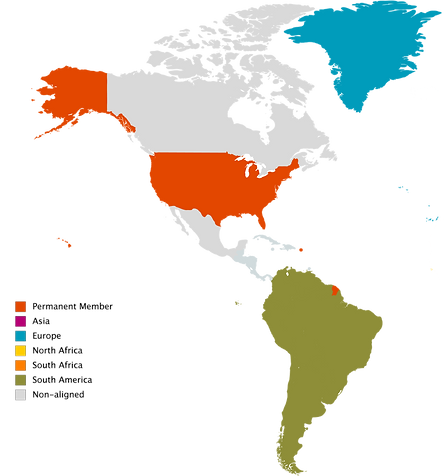
PERMANENT MEMBERS WITH INDEPENDENT VETO
China
France
Russian Federation
United Kingdom of Great Britain and Northern Ireland
United States of America
PERMANENT MEMBERS WITH ONE VETO BY UNANIMOUS DECISION BY REGION
Asia
India
Indonesia
Japan
Pakistan
United Confederate Republic of Korea (UCRK)
Europe
Germany
Italy
Poland
Portugal
Turkey
North Africa
Algeria
Central African Republic
Egypt
Ethiopia
Nigeria
South Africa
Angola
Democratic Republic of the Congo
Kenya
Madagascar
South Africa
South America
Argentina
Brazil
Colombia
Uruguay
Bolivarian Republic of Venezuela
Other
Australia
Canada
Mexico
Saudi Arabia
Singapore
-
The United Confederate of Korea is a fictionalized interpretation of the unification of the Democratic People’s Republic of Korea and the Republic of Korea. This unification was enacted with the Daeseong-dong Treaty of 2018, which saw the invasion of the DPRK by the United States led task force - Operation Rocket Man - and the toppling of the Kim Regime. Former defence chief Pak Yong-Sik and Joint Chiefs of Staff Chair Ri Myong-su (whom Kim Jong Un had relieved of duty after they saluted Republic of Korea President Moon Jae-in in 2017) successfully lead a military coup that saw the relatively peaceful end of the DPRK. Kim launched a failed ICBM attack on the Russians and Hawaii: following this there was an emergency UNSC meeting that lead to the continuation of the Korean War. Fortunately, there were no casualties to Seoul, nor to Pyongyang - civilian casualties were fewer than a thousand on either side. There were, however, close to four million DPRK servicemen killed or wounded in action, and close to five hundred thousand casualties on the US led coalition, which consisted of the Republic of Korea, Japan, Thailand, Malaysia, Indonesia, the Philippines, Belgium, France, Germany, the United Kingdom, Canada, Australia, New Zealand, Russia, and the People’s Republic of China. The former DMZ is currently being de-mined under the joint supervision of the coalition and the United Nations, while the country was restructured to have one central government. The former DPRK has received humanitarian aid and has been “colonized” by the South - integrating normal modernized luxuries to the North. This has put a tremendous strain on the country’s economy and resulted in massive outstanding loans from the World Bank and the International Monetary Fund (IMF). Overall social tensions are high but not detrimental.
NON-PERMANENT MEMBERS WITH ONE VETO GIVEN
UNANIMOUS DECISION BY ALL MEMBERS
Afghanistan
Belgium
Côte D’Ivoire
Dominican Republic
Equatorial Guinea
Estonia
Ireland
Israel
Kuwait
Maldives
Netherlands
New Zealand
Norway
Peru
Philippines
Qatar
Romania
Rwanda
Saint Vincent and the Grenadines
Senegal
Slovenia
Thailand
Togo
Uganda
Ukraine
United Arab Emirates
United Republic of Tanzania
Vietnam
Yemen
Zambia
bottom of page